
Maybe your IT team has suggested Drupal for the new website. Maybe a proposal landed on
your desk with “Drupal” all over it. Either way, you’re about to sign off on a platform you may
know little about. That’s a fair position to be in, and it’s exactly who this guide is for.
Here’s the short answer. Drupal is free, open-source software for building and running websites.
Your team uses it to write pages, publish news, and manage who can edit what, all without
touching code. Underneath, it’s built to handle big, busy, multilingual sites that need to stay
secure for years.
Drupal has been around since 2001, when Dries Buytaert released the first version. Today no
single company owns it. A global community of developers keeps it going, with support from the
non-profit Drupal Association. In practice, that means two things: you never pay a licence fee,
and you’re never locked in to one vendor.
How Drupal works, without the jargon
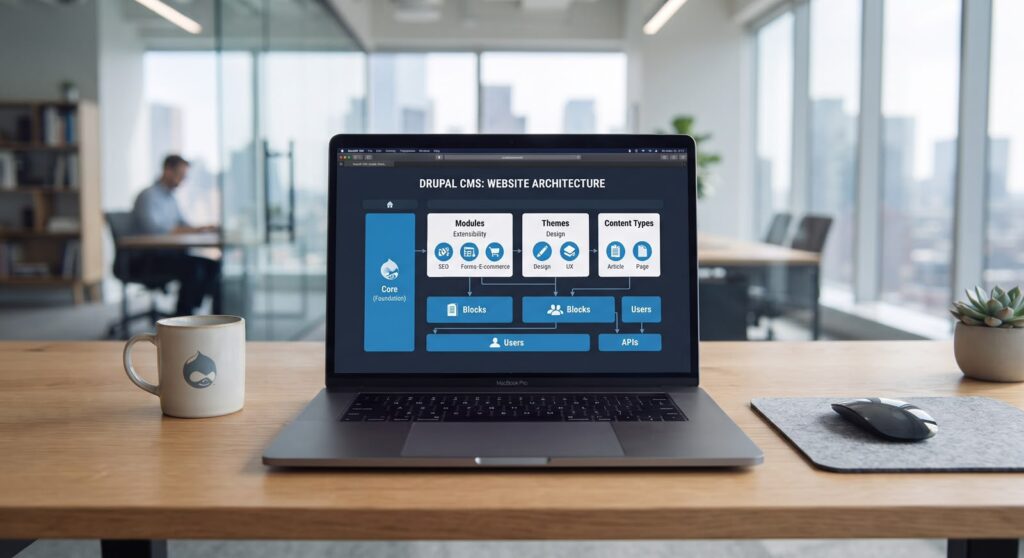
It helps to picture a Drupal site as a building with three parts:
● Core is the foundation and the structure. Every Drupal site runs on it, and it handles the
essentials: content, user accounts, permissions, languages, and security. It gets updated
on a published schedule, so you always know what’s coming.
● Modules are the extra rooms you add when you need them. Want a contact form, better
search, SEO tools, or a payment gateway? There’s probably a free module for it on
drupal.org. If there isn’t, a developer can build one.
● Themes are the interior design. A theme takes your content and turns it into what
visitors actually see, on a laptop or a phone.
For developers, Drupal is written in PHP and keeps your content in a database such as MySQL
or PostgreSQL. For everyone else, it’s simpler than that. You log in through a browser, write or
edit a page, send it for approval if needed, and hit publish.
Free Audit
Find out what's holding your business back.
Our specialists will review your digital presence — no cost, no commitment.
Book a Free Call ↗Where Drupal shines, and when it doesn’t
Drupal earns its keep when a website gets complicated: lots of content, lots of editors, more
than one language, and real security expectations.
Take languages. In the UAE, most serious websites need Arabic and English, and Arabic means
right-to-left layouts. Drupal has multilingual tools built into core rather than bolted on, so a
bilingual site is a normal use, not a workaround.
Then there’s control. On a big site you rarely want everyone publishing everything. Drupal lets
you set detailed roles and approval steps. A writer drafts, a manager reviews, legal signs off,
and only then does the page go live.
Security is the other big one. Drupal has a dedicated security team that reviews reported issues
and publishes fixes on a regular schedule. Add structured content, easy connections to CRMs
and single sign-on, and freedom to switch agencies or hosting whenever you like, and you can
see why larger organisations choose it.
But Drupal isn’t the answer to everything, and we’d rather tell you that up front. If you need a
five-page brochure site by next week on a tiny budget, it’s probably overkill. If you’re building a
pure online shop, a dedicated e-commerce platform may be simpler. And if no one on your side
or your agency’s knows Drupal, that’s a real cost to factor in.
The honest rule of thumb is this: the more your website looks like a system rather than a
brochure, the more sense Drupal makes.
Who uses Drupal in the UAE?
You’ll find Drupal behind the kinds of websites that can’t afford to get things wrong. Here’s what
it typically handles for different organisations:
| Organisation | What Drupal typically handles |
| Government and semi-government entities | Bilingual service portals, e-services, news and strict approval workflows. |
| Universities and schools | Dozens of department sites, course listings, events and many editors. |
| Healthcare groups | Doctor directories, clinic pages and appointment integrations. |
| Banks and financial services | Product pages in several languages, with security reviews built into publishing. |
| Large groups and enterprises | Several brand or country sites run from one platform. |
| Media and publishers | High volumes of articles, authors and sudden traffic spikes. |
The common thread isn’t industry. It’s scale: a lot of content, a lot of people touching it, and a lot
riding on it staying secure.
Drupal today: which version should you care about?
If you’re starting fresh or upgrading in late 2026, Drupal 11 is the version to be on. Here’s how
the rest fit in.
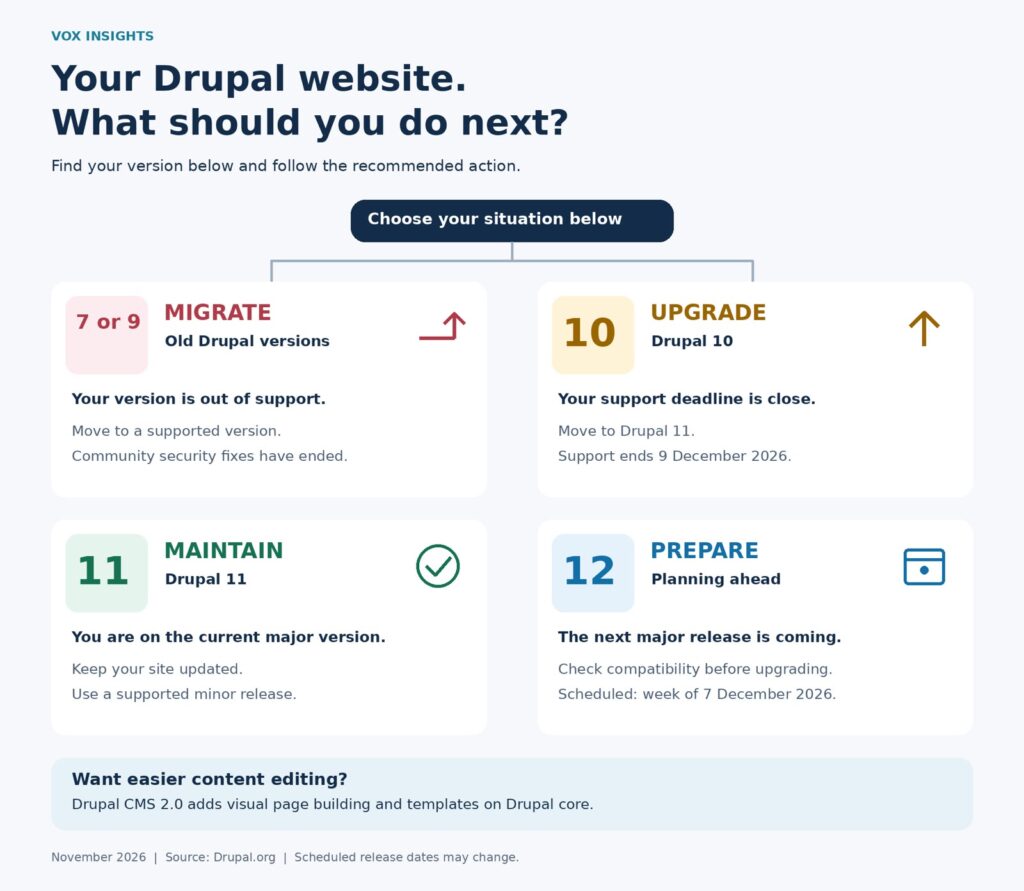
The one to watch is Drupal CMS 2.0. For years the knock on Drupal was that it was hard for
non-developers. Drupal CMS 2.0 tackles that head-on with Drupal Canvas, a drag-and-drop
editor with live preview. Marketing teams can now build and change pages visually, while
developers keep the same solid Drupal foundation underneath.
Is Drupal really free?
Yes, and no. The software costs nothing. There’s no licence fee, no per-user charge and no
subscription to the platform itself. What you pay for is the work of turning free software into your
website, and keeping it healthy afterwards.
That work usually covers design and development, moving content over from your current site,
connecting systems like your CRM or payment gateway, and setting up Arabic and English
versions properly. Then there’s hosting, and ongoing support for security updates and
improvements.
One piece of advice we’d give any organisation: budget for maintenance from day one. Drupal
releases updates regularly. Keeping up with them as you go is far cheaper than a big, stressful
catch-up upgrade a few years down the line.
Want a fuller breakdown? Our guide to Drupal website cost drivers walks through what pushes a
budget up or down.
Questions people often ask about Drupal
● What is Drupal, in one sentence?
It’s free, open-source software for building and
managing websites, especially large, multilingual and security-conscious ones.
● Do I have to pay for Drupal? Not for the software itself. You’ll pay for design,
development, hosting and ongoing care, just as you would with any serious website.
● Is Drupal better than WordPress? It depends on the job. Drupal tends to suit complex
sites with many editors, strict workflows and several languages. WordPress is often a
good fit for smaller sites and blogs. We compare the two side by side in Drupal vs
WordPress.
● Can Drupal handle Arabic? Yes. Multilingual support is part of Drupal core, including
right-to-left layouts for Arabic.
● Will my team find it hard to use? Less so than before. Everyday editing happens in a
browser, and Drupal CMS 2.0, released in January 2026, added a drag-and-drop page
builder called Drupal Canvas.
● Is Drupal secure? It has a dedicated security team and a regular schedule of fixes. But
any platform is only as secure as its upkeep. Stay on a supported version and apply
updates promptly
Not sure if Drupal is right for you?
That’s a perfectly reasonable place to be. The right platform depends on your content, your
team and where you want the website to be in three years, not on what’s popular.
At VOX, we’re a Drupal development company in Dubai. We help UAE organisations work out
whether Drupal fits, and then build, migrate and support the sites that need it. Tell us a little
about your website and your plans, and we’ll give you a straight answer, even if that answer isn’t
Drupal.