


Website redesign projects fail or underdeliver for predictable reasons — nearly all of them solvable by doing the right preparation work before a single wireframe is drawn. We have managed dozens of redesign projects for UAE businesses, from SME brochure sites to enterprise platforms. The businesses that get the most from their redesign investment are the ones that treat the pre-launch phase as seriously as the build itself.
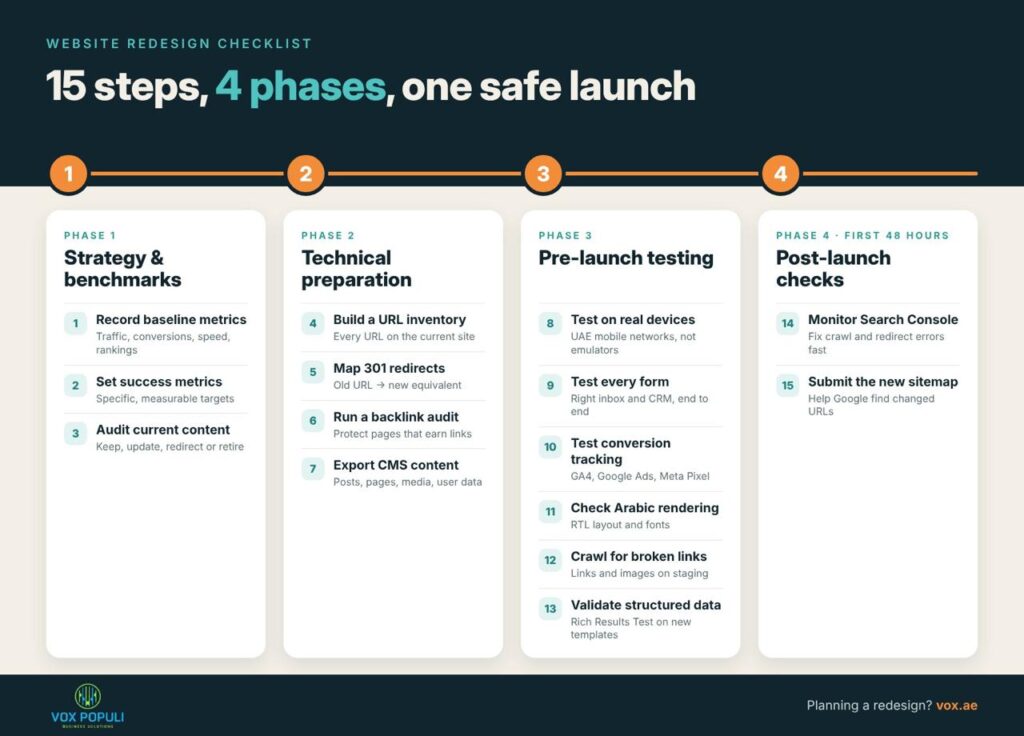
Before You Start: Strategy and Benchmarks
- 1. Document your current baseline metrics. Record your current organic traffic, conversion rates, page load speeds, bounce rate, and ranking positions for key terms. Without baseline data, you cannot measure whether the redesign improved anything.
- 2. Define success metrics for the new site. Specific targets: “increase contact form submissions by 30%,” “improve mobile PageSpeed to 85+,” “maintain or improve current keyword rankings.” Vague goals produce vague results.
- 3. Audit your current site content. Inventory every page. Decide for each: keep, update, redirect, or retire. Many UAE businesses carry 40 to 60% of content that is outdated, irrelevant, or cannibalising other pages.
Technical Preparation
- 4. Create a complete URL inventory. Export every URL on the current site. Every page that has inbound links or organic rankings needs to be either preserved at the same URL or redirected correctly.
- 5. Map redirects before launch. For every URL that will change (and they will change in any meaningful redesign), document the redirect destination. Implement 301 redirects from old URLs to new equivalents. Missing redirects cause immediate ranking drops after launch.
- 6. Conduct a backlink audit. Use Ahrefs or Semrush to identify your most valuable inbound links and the pages they point to. These pages need to be preserved or redirected correctly — a broken link from a high-authority UAE publication is a significant SEO loss.
- 7. Export all existing content from the current CMS. Before the old site goes offline, export or archive all content — posts, pages, media, user data. This cannot be done after the switch.
Pre-Launch Testing
- 8. Test on real devices in UAE. Test the site on actual mobile devices in UAE network conditions — not just desktop browser emulation. Performance can differ significantly.
- 9. Verify all forms send to the correct destination. Every contact form, quote request form, and lead capture must be tested end-to-end — confirmed delivery to the right inbox and CRM.
- 10. Test all conversion tracking. Verify Google Ads conversion tracking, GA4 events, Meta Pixel events, and any other tracking fires correctly on the new pages before launch.
- 11. Check Arabic content rendering. If the site has Arabic pages, verify RTL text rendering, font loading, and layout on multiple browsers.
- 12. Run a broken link check. Use a crawler (Screaming Frog) to identify any broken internal links or missing images on the staging environment before launch.
- 13. Verify structured data markup. Test schema markup with Google Search Console Rich Results Test. Structured data that was working on the old site may need to be updated for new templates.
Post-Launch (First 48 Hours)
- 14. Monitor Google Search Console for crawl errors. New crawl errors will appear within hours of launch — check immediately and fix redirect issues before they accumulate.
- 15. Submit updated sitemap to Google. Submit the new sitemap.xml in Search Console to accelerate recrawling and reindexing of new and changed URLs.
If you are planning a website redesign for your UAE business and want to make sure it does not damage your current rankings or performance, speak to our web development team. We manage the full technical migration alongside the design and build.
Free Audit
Find out what's holding your business back.
Our specialists will review your digital presence — no cost, no commitment.
Book a Free Call ↗